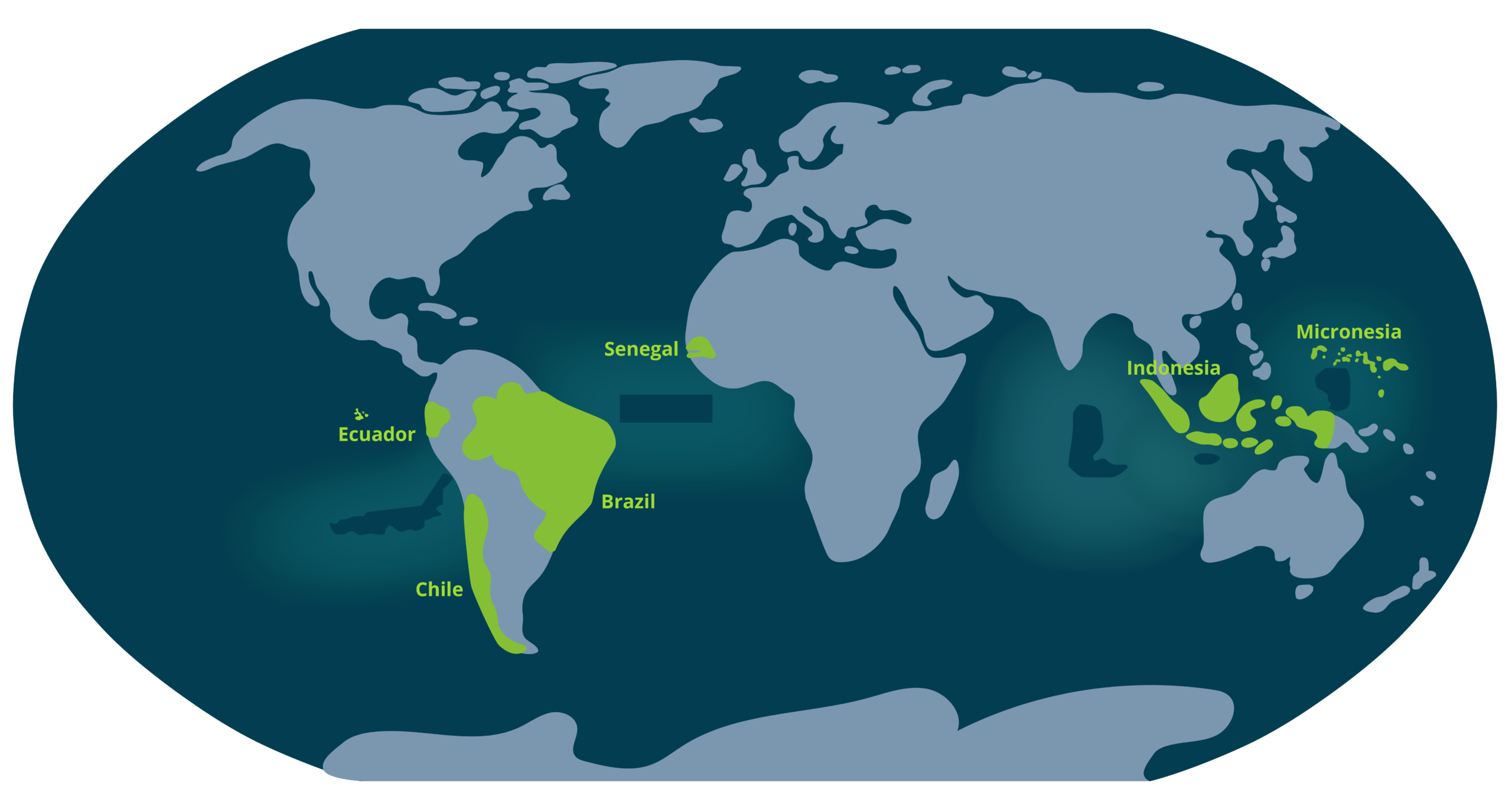
Guided by the diverse portfolio of ecologically or biologically significant marine areas (EBSAs) established under the Convention on Biological Diversity (CBD), five ocean areas known for their high biodiversity value have been selected in the Atlantic, Indian and Pacific ocean basins. They serve as broad starting points in which potential candidate sites for area-based management tools (ABMTs) proposals, including marine protected areas (MPAs), will be sought and co-developed.
Ecological connectivity of these scoping regions with the wider ocean will be an important consideration.
Tap on a hotspot to learn more about each target region.
The focus on large, scientifically complex EBSAs in the equatorial belt is a deliberate choice: sites here are already being impacted by climate change and human activities and may merit varying protection levels.
These five target regions are diverse in their characteristics and have potential to yield a range of feature-specific sites for ABMTs, including MPAs. This offers opportunities to consider a diverse taxonomy of ABMTs, including MPAs, and zoning concepts within different contexts and involving varying constellations of countries, competent authorities and networks of scientific and civil society actors in ABMT/MPA co-development and future management – thus providing opportunity to develop various blueprints and best practices to foster replication around the world.

These ridges extend over 2,900 km, encompassing 41% of the seamounts in the southeastern Pacific. They exhibit high levels of marine biological endemism and are important for migratory species. A collection of stable static features, these two sequential chains of submarine mountains lie south of the Galapagos (Ecuador) and west of Chile.
in the central Atlantic combines a wide spectrum of historical, geological, oceanographic and biodiversity features. Deep benthic habitats including vents and seeps, the interface of circulation patterns and seasonal surface plankton blooms combine to make this ecosystem particularly significant. A dynamic EBSA, it extends beyond the national jurisdiction of Brazil across the Atlantic and connects with the Guinea Basin offshore western Africa.
is a persistent ephemeral feature of high importance for migratory species in the eastern Indian Ocean. It serves as a key seasonal feeding site for migratory seabirds, fuelled by phytoplankton blooms during the austral winter, and is situated west of Indonesia. Migratory pathways, corridors and flyways connect species with countries in the Western Indian Ocean and make this site particularly relevant to Convention on Migratory Species (CMS) resolutions.
is also an ephemeral feature of high importance for migratory species in the eastern Indian Ocean, with high seasonal productivity driven by currents and upwelling from the south Java coast. It is the only known spawning area of Southern bluefin tuna, is significant for other migratory species and lies between Indonesia and Australia. It is equally important to CMS resolutions.
in the southwestern Pacific includes a number of important static features, such as ecologically rich coral reefs and seamounts boasting an abundance of rare and endemic species, such as commercially threatened tuna and endangered seabirds. It links national jurisdiction of Micronesia, Papua New Guinea and Indonesia, extending into ABNJ.